Finding great developers in today's market is a challenge, everyone is busy and rates are high, but where do you even start looking? I sat down and put together 3 different strategies for casting as wide a net as possible.
Recently on an engagement we needed to reinforce the team with more developers. Since we had built up the team with individual people from different consulting firms and independent consultants, it was not simply a case of ringing the vendor and saying we needed to reinforce the team. There was no vendor. Time to roll up the sleeves myself.
Before we jump into the different approaches, I thought I would first touch on the philosophy of finding the right person. A friend and former colleague described their philosophy of recruiting and it just felt right. What is it?
It is better to get many CVs and go through them than few. It simply gives you a larger selection.
Have as few hard requirements as possible (experience is that especially women are put off by long tech lists. If they cannot do everything, they do not apply).
Describe what makes the workplace fun. Get many people to want to dare to apply.
It is no harder than that. Then how you shape an ad or copy that gives results for your particular case requires an open mind and testing, testing and testing.
1. Consulting firms
After quite a few years in the industry I have over the years built up contacts with a number of known consulting firms that are reliable, good to work with, and have a reasonable number of employed people with good skills. So it was just a matter of sitting down and emailing, texting and calling all my contacts there. When you contact the consulting firms it is important to have a reasonably clear but simple list of requirements to be met, ideally in 2 tiers: absolute must and nice to have. That can be, for example, language requirements or technology requirements.
You should be prepared for getting many CVs that are mostly a rough match. The consulting firms have people on the bench or on their way out of engagements and will try to profile these people to fit. If you have written some requirements, their CVs will likely be rewritten so that your buzzwords make it into skills lists or engagement descriptions. The consulting firms will also go back through their sub-consultant contact chains and ask around. This builds chains where everyone wants a cut in between. At the end sits an independent consultant or another consulting firm getting 750 SEK when you pay 1,250 SEK per hour. I have experienced chains with up to 4 companies in between. There is basically nothing wrong with that other than my experience is that you do not find the best experts in such a long chain.
2. Contacts
It is without doubt the absolute best method for finding good and capable people, but requires that you have a broad network of people who like what you do and know that if you recommend someone, that person will not end up in a hell. Step 1 is of course asking directly among people you know, but equally important are their friends and networks.
I chose to think through what could attract skilled people and formulated a more personal pitch about who they would work with and their skills, what the goal of the project is, and what we needed help with. Then it was just a matter of starting to contact all the good developers and other people with broad developer networks I had worked with over the years and ask for help. Here it is much more about building personal relationships, and if a tip comes in, humbly get contact info and be given a call. You obviously need to do an interview and see that you click culturally and so on. But my experience is that if a great developer recommends another person as capable, that person will be great too. Then the technology will sort itself out quickly. Doing beats knowing any day of the week.
3. Random / marketing
My last hope came down to chance in two different ways.
Social media
I recorded a short video with my phone where I briefly described what I was looking for, where I tried to be friendly, not talk business corp-speak, and just stand out a bit. Out with the video and accompanying explanatory text on LinkedIn, and I asked a few people I know to share it so it got a bit of reach. It actually gave quite a few leads, though of very varying quality. But I was not exactly overwhelmed with bad CVs, and got quite a few good leads, so worth it after all. Worst case, it was a bit of LinkedIn marketing. "I exist."
Searches
I simply sat down at the computer and Googled for companies working on similar things to what our project is solving, or technologies we work with, and emailed or called them about consultants and tips. That gave very good results, several extremely qualified tips. Because distance in today's reality is not a problem, a tip about a consultant sitting 100 km away is as good as one sitting 100 metres away. It is the skill that decides.
When you finally have a CV or a contact, it is time for the interview, that is another problem for another text. It is perhaps the hardest thing there is. But as I said, first you have to have a strategy for even getting hold of someone to interview.
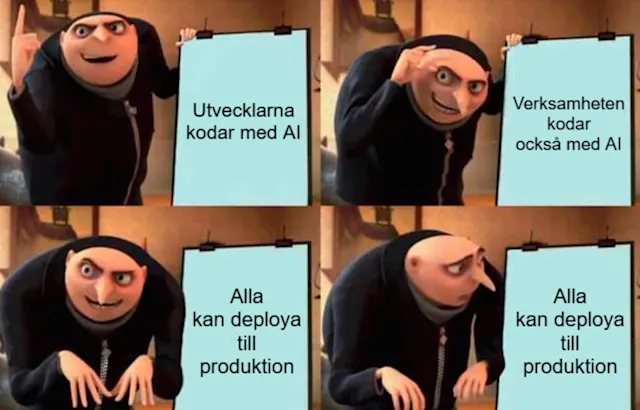
AI does not only make development faster, it moves the capability out into the whole organisation. Suddenly anyone can build and change things in the systems. It is enormously powerful, but combined with old ways of working it leads to either chaos or no effect at all. Here is how you lead the shift from tree-tender to forest ranger before entropy runs away from you.
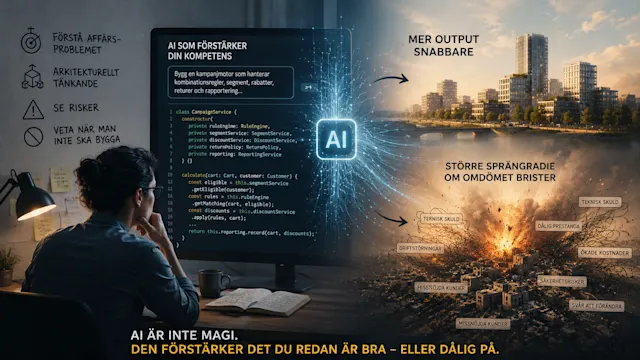
AI makes it possible to produce code faster than ever, but more code does not automatically mean more value. What AI really does is amplify the skill and judgement already present in the person or team using it. That makes the ability to understand the problem, spot risks and know what not to build more important than ever.
Communicating with others is harder than you might think. It is also one of the most important success factors in any project, because if we can understand each other, we can also work together. I have collected a few things that I think make a real difference day to day. It may sound obvious, but I have seen more than one project fail because of poor communication. With small means you can influence more than you think.