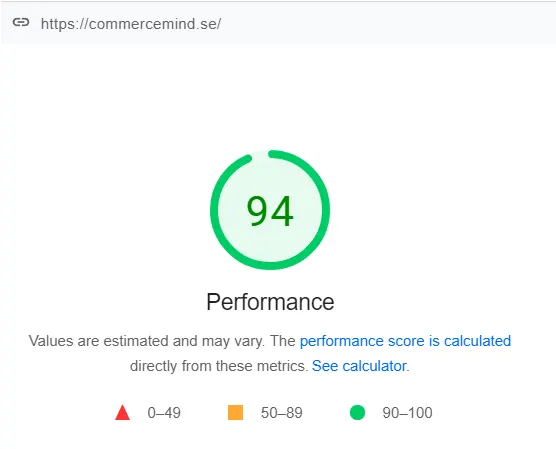
Everyone knows performance and site speed matter for e-commerce. But the discussion is rarely nuanced. Why is performance important? And what is the difference between having good and really good performance? Or the difference between OK performance and good performance?
The mistake many make is to see performance as a technical detail to be ticked off: "we need a fast site" and then not defining it any further than that. But the truth is that performance is a KPI like any other that should be invested in, measured and followed up. Most people miss this because it is so hard to show increased or decreased sales in relation to improved or degraded performance.
Google PageSpeed
There are quite a few performance tests you can run on your site to get a rating of how fast it is. Of these, Google PageSpeed is the most popular but also the hardest, because Google has a self-interest in how they rate sites. If you take two e-commerce sites and browse around on them and form an opinion of which is fastest, it is far from certain that the one you like best has the highest score on Google PageSpeed. Or that you think they are roughly equally good but one can have twice as good a score as the other.
Why is that? Google PageSpeed is a very important tool, but it does not measure the whole customer experience. Google recently announced that your score is a clear factor in how highly you rank on Google. The sites with a passing grade on Core Web Vitals , which is part of the PageSpeed score, automatically get a boost in Google ranking. Google as usual is not particularly clear about how big an effect it has, but one clear effect is that Google pushes for these sites in the same way it previously pushed sites built in the AMP format , and that it increases your chance of appearing in Google Discover.
Google's self-interest
It is easy to think that Google has altruistic motives and just wants to help the world get faster sites. And that is certainly partly true, but they would not have invested so much if they did not have entirely their own motives for it. The reason it is important for Google that sites should be fast is because how fast your site is is part of Google's overall user experience. If you search on Google and go back and forth between sites and search results, it is important for Google that those sites load fast. If they load slowly, the perception is that Google is slow. This is a big reason why Google developed the AMP format and why more and more information is made available directly in the Google result without you having to leave Google.
Today more and more e-commerce sites are built as SPAs (Single Page Applications) and one effect of that is often (but not always) that the first load is slower while the internal navigation is much faster. The internal navigation on the site is not part of your PageSpeed score because Google simply does not measure it. Your internal navigation is not part of Google's user experience anywhere near as much as the initial load.
When you do a PageSpeed measurement you often see results you do not recognise at all. It may say that it takes 20 seconds before the site has finished loading, but when you test it yourself in your mobile it takes maybe a couple of seconds. That is because Google's measurement is made with a worse network and a worse mobile than what you and perhaps your customers have. Google has a big interest in countries with limited access to fast internet and fast mobiles also getting a good experience. This too is not charity, but Google wanting to reach emerging markets and not lose them to Facebook and other competitors.
Google has recently improved this by showing a clearer difference between Field Data and Lab Data, where Field Data is data your real customers have reported in and Lab Data is the data Google's test servers give when you do a measurement. Which is very good, but it is still the case that the score number from 0 to 100 is based on Google's test servers rather than on what real customers experience.
SEO budget vs performance budget
PageSpeed is a tool you as an e-commerce operator have to work with, but you should not make the mistake of believing it is the only performance tool you need. PageSpeed should rather be seen as an SEO tool. In the same way that it is important for SEO that you have the right meta tags, the right URL structure and the right internal linking, it is important for SEO that you have as high a PageSpeed score as possible.
How high a score you should aim for should be judged based on how much increased sales you think you can get from it. High PageSpeed score is not the vegetables on your plate, it is something that requires investment, and in the same way as all other investments it should be decided on ROI. To get a really high score you often have to make compromises. Third-party scripts added via Google Tag Manager are a classic example of something that lowers your score. Custom fonts are another. If you want a really high score, you may need to deselect these, and you need to take a position on which gives you the most customer and business value. High PageSpeed is also something that requires time and energy from your developers, so plan for a certain part of their capacity to be spent on continuously making sure you have a high score. If you are facing a platform switch on your e-commerce, you need to be careful to make sure that platform can even deliver the score you want. Do not get fixated on the score other sites have on the platform you are looking at, because it is rarely entirely the platform's fault, but if all sites on that platform have low scores, it is a strong warning signal.
If a large share of your revenue comes from Google searches, it becomes obvious that high PageSpeed matters. If a large share of your customers come to you via sources other than Google searches, you may need to put more of that investment elsewhere.
Nothing beats measuring on a real mobile
So how should you measure performance without relying entirely on PageSpeed? First and foremost, you need automated tests that measure and save the result so you can see historical trends. Here it is not enough just to measure the homepage, but the more page types you can measure the better. A very good complement to PageSpeed is WebPageTest which is an independent and very detailed test that can help you find simple mistakes.
But the absolute most important test you should do is to get one or more mobiles that are representative of your customers, and browse your site with those devices on a network that is also representative.
Performance is often measured in milliseconds in various types of technical results, but if you only do that you risk missing the forest for the trees. It does not matter if you have super-fast response times if the total experience on a real mobile is not also really fast.
Set up a number of scenarios that are typical for your customers and set aside half an hour a week to manually go through them on the mobiles you have acquired. Examples of scenarios are:
1. Go to a category, into a product, and back to the category. Go back and forth between the category and new products. This is a very common scenario for customers who do not really know what they want, and it is incredibly important that it goes fast and does not jump when you navigate back and forth.
2. Go to a category, scroll to the bottom and load more. Then go into a product and go back. Here you should land right at the spot where the product you clicked on was, without it jumping. Many e-commerce sites fail to deliver a good experience here, and it leads to great frustration among customers who do not know exactly what they are looking for.
3. Do a Google search on a product, put it in the cart and go to checkout to complete the purchase. If you have a lot of traffic from Google or price comparison sites, this is a scenario that has to be completely frictionless.
Do these tests continuously against your own site, but at least as important is to do the same measurement against your competitors. Write down comments and ideally your own rating so you can get a sense of whether it is getting better or worse.
Performance is UX and UX is performance
These tests are at least as much UX tests as they are performance tests, which is the whole point. Performance is part of your UX. You cannot split performance into something technical and UX into something your designer does. These two are connected to the point that you should never separate them. If the experience is that your site is really fast, it matters less what the numbers say, because then probably your developers and UX designers have been good at creating an experience that does not hang on fast numbers. In the end, everything is about the experience you give your customers, and there you should never compromise.