If we view e-commerce as core business, why are we so inclined to hand the entire responsibility for developing it over to external vendors? We very rarely do that for other sales-critical or operationally critical activities. Taking control over your own e-commerce destiny and starting to lead development yourself, with employees or hired-in expertise, is a clear trend in the market today. The alternative can be too embarrassing for those who understand what it means. Here I try to give some background on the phenomenon of 'insourcing e-commerce development' and offer a few concrete tips and tricks to take with you if you are thinking along those lines.
"Together with the board I have defined that our e-commerce is a strategic priority for the next three-year period," said the CEO in a meeting the other day.
"We will make a larger investment in the area and additionally open up a new e-commerce for our B2B customers. Can you put together a plan and a business case for our future growth? It is enough if it is ready by Thursday"
Historically, many heads of e-commerce have had a knee-jerk reaction to a question like that: to get in touch with a full-service provider of e-commerce and IT development. A larger consulting firm, quite simply. "Let us start a new big project where you do everything from A to Z. Preferably at a fixed price".
But if we calm down for a moment and think about what we are actually being asked to do. What other, really strategic and company-defining activities would we ask an external consultant to take overall responsibility for?
Establishing the company in a new market? Hardly.
Developing a new product category? Not in a million years.
Replacing strategic suppliers? Nope.
Reorganising the sales force with new goals and processes? Not likely.
So why do we tend to do it with e-commerce, then? There are probably many, mostly historical reasons for it, but I think it boils down to two main reasons:
E-commerce has not been seen or treated as core business, but more as a nice complement to the "real sales" in stores, by customer service or by physical sales staff. Getting a traditional sales manager to burn as brightly for digital conversion rate as for closed deals is a challenge. Getting the traditional marketing manager to be as enthusiastic about a new relevance engine as about a store opening in Nynäshamn is hard.
The internal competence and experience to develop the e-commerce and the ability to buy in e-commerce competence have not been there. Easier then to point at a pitching vendor who gets to take overall responsibility. If it goes wrong you know who to blame, and it is just a matter of switching vendors. In theory.
That so many hand over so much control over a part of their core business dumbfounds me. Time and again. For the vast majority of selling companies, e-commerce is core business. Or at least should be. And blaming a lack of internal competence no longer holds. The competence is out there if you are ready to look for it.
If you agree with me that it is important to take back control of your e-commerce and its development, I have a short list of activities in priority order:
Get buyer competence and experience of e-commerce.
Hire in competences in the form of specialist consultants.
Employ your own competence.
For companies that started in the digital era (post 2015-ish) and mainly have their sales through digital channels, and perhaps even digital distribution, having their own leadership and control of their e-commerce is a given. There are basically no alternatives. They would not think of doing it any other way.
If you are thinking of insourcing (horrid word, I know), or "bringing home leadership and responsibility for the development of your e-commerce", there are a few things that are good to bring along, and a number of pitfalls you can end up in if you have not thought it through and prepared:
Are there internal processes and ways of working in place for, for example, requirements work, quality assurance, prioritisation, incident handling and so on? Processes a consulting firm perhaps drove before. That you as buyer perhaps did not even know existed. Map the white spots first.
Will employees working with your e-commerce have enough to do over time? Or will there be high peaks and deep valleys? Or just 50% over time? Never employ solely for a specific project.
Competence and experience development of colleagues is now your responsibility. How do you ensure it?
Project methodology and project management tools? Work with waterfall, SCRUM, Kanban? Use Jira, Trello, MS Project? Communicate with Teams, Slack or Confluence? It quickly becomes the wild west if everyone gets to choose their own favourite.
With your own employees you often become vulnerable in connection with illness, parental leave or resignation. Plan for different scenarios with backup plans. Be prepared to slow the pace of development if it happens, or arrange backup capacity.
If you employ, make sure you really can evaluate candidates' competence when you employ. Can you personally really evaluate a UX designer's conversion knowledge? A .NET developer's experience of operational e-commerce?
For a specific competence, is employment or hired-in specialist consultant the best solution? Short or long term? Experience and competence can be more important than contract form. Try to be flexible with this during the recruitment process. And if you are the least bit uncertain about the need or the individual, choose to hire in an individual with specialist competence rather than employ. Remember: the important thing is to take back control of the core business e-commerce, not to build a large team of employees.
If you still choose to kickstart your development with a vendor that takes overall responsibility until delivery, make sure you engage yourself to the maximum in the project so you can take over control of the e-commerce and its platform at a suitable moment. Perhaps work with mixed hybrid teams during a transition phase?
As selling companies become more mature within e-commerce and understanding grows that e-commerce is core business, we will see more companies take over control and leadership of e-commerce projects and management.
If you agree with these insourcing thoughts, just reach out to someone who has already gone through the process, or is already in a situation where they have control of their e-commerce. Do not be afraid to approach other e-commerce operators with questions. Most people love to share their experiences.
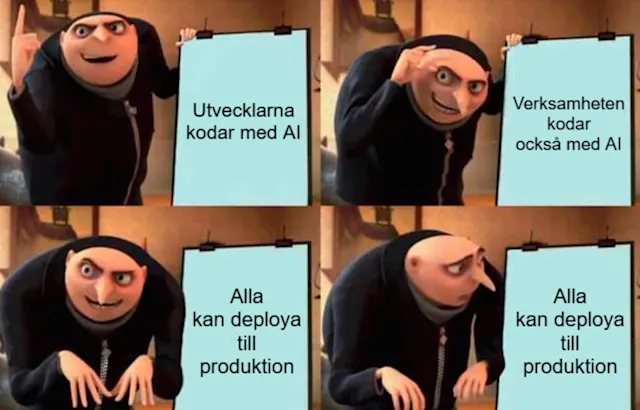
AI does not only make development faster, it moves the capability out into the whole organisation. Suddenly anyone can build and change things in the systems. It is enormously powerful, but combined with old ways of working it leads to either chaos or no effect at all. Here is how you lead the shift from tree-tender to forest ranger before entropy runs away from you.
AI makes it possible to produce code faster than ever, but more code does not automatically mean more value. What AI really does is amplify the skill and judgement already present in the person or team using it. That makes the ability to understand the problem, spot risks and know what not to build more important than ever.
Technical debt is more than a technical concept, it is a business-critical reality that affects everything from time-to-market to customer experience. In e-commerce, where every millisecond and every click counts, the choices you make in your technical platform can have far-reaching consequences. When quick fixes are prioritised over long-term durability, an invisible but growing debt is built up. It affects not only development speed and stability, but at worst can slow the company's ability to innovate and compete. To face the future the right way, technical debt has to be understood, quantified and managed as the strategic investment it actually is.