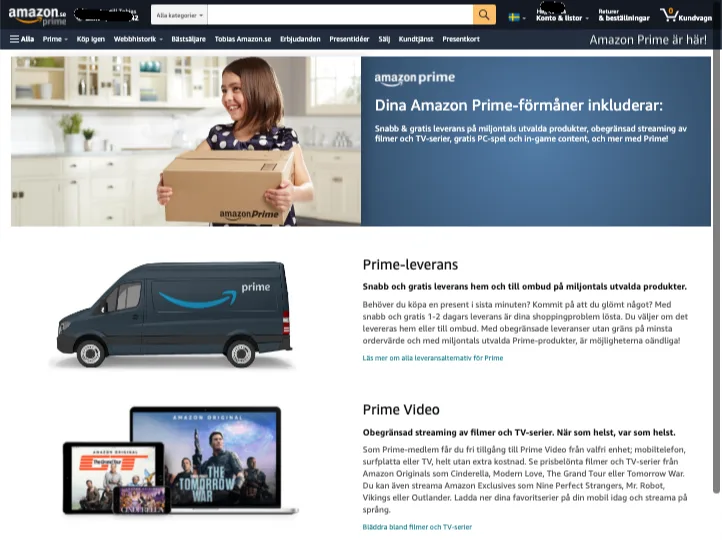
In 2005 Amazon launched its loyalty programme in the US. Since then it has grown to more than 150 million members in the US and over 200 million globally. The question we are now asking ourselves is how it will play out here in Sweden.
It is now almost to the day one year since Amazon opened its doors in Sweden. Many of us had a good laugh at the fantastically bad machine translation, and initially there was a lot pointing to a failure for Amazon, with a fairly limited assortment and long delivery times.
It has been fairly quiet about Amazon's Sweden push for a while now, and sales have not taken off. But I was not surprised when Amazon today announced that they have launched Amazon Prime in Sweden. What for so many years has been a given and a part of daily life in the big country to the west, with over 150 million members, can now start to get a foothold here too.
So how will one of the world's largest customer clubs, with over 200 million members, fare here in Sweden?
A recent study from the US says that 66% of all visitors find everything they need on Amazon and therefore see no need to visit other e-commerce operators. All my friends in the US always start their purchase journey on Amazon, and usually finish it there. A kind of "internet for products", quite simply, where Prime reinforces the offer with its free shipping and fast deliveries.
Going onto a site and finding everything you need sounds quite far from daily life in Sweden as we know it. Is there really an equivalent in Sweden? Hardly. It would be a kind of combination of Clas Ohlson, Gekås, IKEA and Zalando. Something like that. It will definitely be interesting to see how or if our buying behaviour changes as Amazon expands its toolbox here.
28% of visitors have finished shopping in under 3 minutes.
Read that sentence again. However you look at that number, it is incredibly impressive that with Amazon's assortment they make it so easy for the customer that they spend so little time to complete a purchase.
69% of everyone who signs up for "a free trial" converts to customers in the US.
Here too, many companies can look and learn. The trial is there for you to have time to test around and try the offer. Clearly Amazon lives up to the high expectations that exist and creates that added value to make customers switch to paying customers. It will be interesting to see if other players follow Amazon's model going forward. Will we see Rusta's customer club offer free cinnamon buns, or will Stadium offer a free subscription to Vi i Villa?
What challenges do I see with Amazon Prime in Sweden?
The sustainability factorwhat you buy and how you get it delivered. Most consumers would be prepared to wait an extra day for goods to be delivered in a sustainable way. If we are not there today, I am convinced that is where we are heading. So weekend deliveries to central Gothenburg may not be the meaning of life. At least not for everyone.
Selection via games and TV
Buying behaviour
Geographic coverage
On the other hand it only costs 59 SEK per month. Then you get fast deliveries and can watch Clarkson's Farm during Friday cosy time. What's not to like?
AI does not only make development faster, it moves the capability out into the whole organisation. Suddenly anyone can build and change things in the systems. It is enormously powerful, but combined with old ways of working it leads to either chaos or no effect at all. Here is how you lead the shift from tree-tender to forest ranger before entropy runs away from you.
Technical debt is more than a technical concept, it is a business-critical reality that affects everything from time-to-market to customer experience. In e-commerce, where every millisecond and every click counts, the choices you make in your technical platform can have far-reaching consequences. When quick fixes are prioritised over long-term durability, an invisible but growing debt is built up. It affects not only development speed and stability, but at worst can slow the company's ability to innovate and compete. To face the future the right way, technical debt has to be understood, quantified and managed as the strategic investment it actually is.
For Swedish retailers there are plenty of ways to meet this threat by building on what the Chinese giants cannot offer: strong local brand stories, product safety and sustainability as competitive advantages, and a presence that ties digital and physical commerce together. Temu has no stores. Yet.