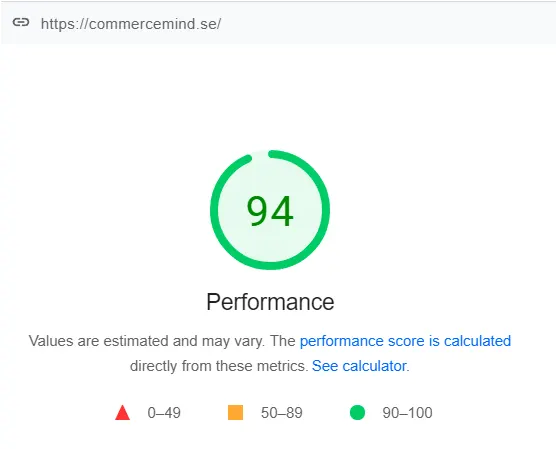
Is it important to get a high Google PageSpeed score?
Getting a high Google PageSpeed score is enormously important for an e-commerce site, but it is also very hard to achieve. Personalisation, modern frontends, Google Tag Manager, tempting images and lots of content are all things that drive sales but can hurt your PageSpeed score. Just how important is a high score, really?
Getting a really high PageSpeed score on an e-commerce site is hard. Fundamentally, the best possible score is given to a completely blank page with no content. Lots of content, many large images, plenty of JavaScript, custom fonts and lots of third-party scripts are all things that lower your PageSpeed score, but they are at the same time things that are necessary on an e-commerce site to present an attractive offer to your customers. And to track customer behaviour to optimise the customer flow.
What are the benefits of a high score?
Google has recently announced that how your site performs on Core Web Vitals is a contributing factor in how high up your site ranks in Google's search results. Google has always hinted that the performance of the initial page load affects ranking, but has never before given such clear signals of how. Core Web Vitals is part of the PageSpeed assessment, but the data used to determine ranking is performance measurements from your real customers who have consented to sending anonymised data to Google. So you cannot cheat your way to a high PageSpeed. The site has to be fast for your real customers.
I think we can all agree that performance matters and that it is important to give your customers a nice and fast experience when they shop. But a high score does not automatically mean a nice and fast experience, in the same way that a low score does not automatically mean a slow and poor experience. A high score is an indicator of a good experience, but so many factors come into play.
Why is a high score important for Google?
Simply because the user experience on your site is part of Google's overall user experience. If a customer searches on Google and moves back and forth between search results and different sites, and those sites are slow, the customer's experience is that Google is slow. Which is a big contributing factor to why Google focuses so much on the initial page load and basically does not care about how fast and good it is to navigate within your site.
This is what led Google to develop the notorious format AMP (Accelerated Mobile Pages). When people searched for information they often landed on very slow news sites with lots of popups and jumping content. Trying to find information via Google became more and more annoying because of that, and AMP became a way to solve the problem. With AMP, Google could guarantee that it was a fast user experience going between search results and different sites. Which was of course the reason Google chose to place AMP sites higher up in search results than other pages. In Google's most recent update, the restriction that only AMP sites get placed higher up has been removed, and now sites with sufficiently good Core Web Vitals scores are included too. How your site performs on Core Web Vitals is found in Google Search Console.
So it is important to understand that Google is not a kind search engine doing everything it can to send traffic to you. Google wants, as much as possible, for customers to stay on Google and click on sponsored content. How important a high PageSpeed is for you depends heavily on how much of your revenue comes from Google traffic. And how important the performance of the initial page load is depends heavily on how long your customers spend with you before they make a purchase. If they come in from Google or somewhere else and make a quick purchase, the initial load has a big impact.
1. How much of your sales come from Google searches, and how competitive are you on Google?
PageSpeed and Core Web Vitals are one of over 200 signals used to determine ranking, so your ranking does not stand or fall with a high PageSpeed. But if you and your competitors have roughly the same offer and are roughly equally good at search engine optimisation in general, your PageSpeed score can be what makes you rank higher than them.
2. What share of returning customers do you have, and how long is your average session time?
3. Are you planning to enter a new market?
Entering a new market is hard, and getting traffic in via Google to build your brand in the new market becomes important. Organic Google traffic is of course not the only way, but it is a good way to build awareness of your brand in a new market.
PageSpeed score is not the vegetables on your plate
It is easy to think a high score is something you must have, a bit like it being important to eat your vegetables with dinner. What is really the vegetables on your plate is that your site is fast enough for your customers to find it a nice, problem-free experience to shop. But that does not automatically mean you get a high score.
Getting a high score requires investment, and sometimes requires deselecting things to maintain a high score. And to be able to make those decisions, you need to understand how the score affects you and your business. Is it worth deselecting a third-party script to get a higher score? How much revenue do you lose on a lower score, and how much revenue do you lose by not bringing in that third-party script? Unfortunately you cannot always have your cake and eat it, and you need to have a well-thought-through strategy for how important PageSpeed is for you.
AI does not only make development faster, it moves the capability out into the whole organisation. Suddenly anyone can build and change things in the systems. It is enormously powerful, but combined with old ways of working it leads to either chaos or no effect at all. Here is how you lead the shift from tree-tender to forest ranger before entropy runs away from you.
Technical debt is more than a technical concept, it is a business-critical reality that affects everything from time-to-market to customer experience. In e-commerce, where every millisecond and every click counts, the choices you make in your technical platform can have far-reaching consequences. When quick fixes are prioritised over long-term durability, an invisible but growing debt is built up. It affects not only development speed and stability, but at worst can slow the company's ability to innovate and compete. To face the future the right way, technical debt has to be understood, quantified and managed as the strategic investment it actually is.
For Swedish retailers there are plenty of ways to meet this threat by building on what the Chinese giants cannot offer: strong local brand stories, product safety and sustainability as competitive advantages, and a presence that ties digital and physical commerce together. Temu has no stores. Yet.